Auditory Processing Simplified.

Imagine a tiny piano keyboard in your brain, just above and behind your left ear. . .
Now imagine that the keys on this keyboard don’t play musical notes but instead play the speech sounds (phonemes) of the language you were born into. If that’s English, your keyboard will have 44 “sound keys” that were mapped onto your auditory cortex when you were just a baby. (If you were hearing Spanish, your keyboard will have 26 keys; Arabic, 36 keys–each language has its unique sound set.) Your developing brain created a sound map of the language it heard to navigate its new world. This amazing process was complete before you were two years old. (Apologies to audiologists for the rough analogy.)
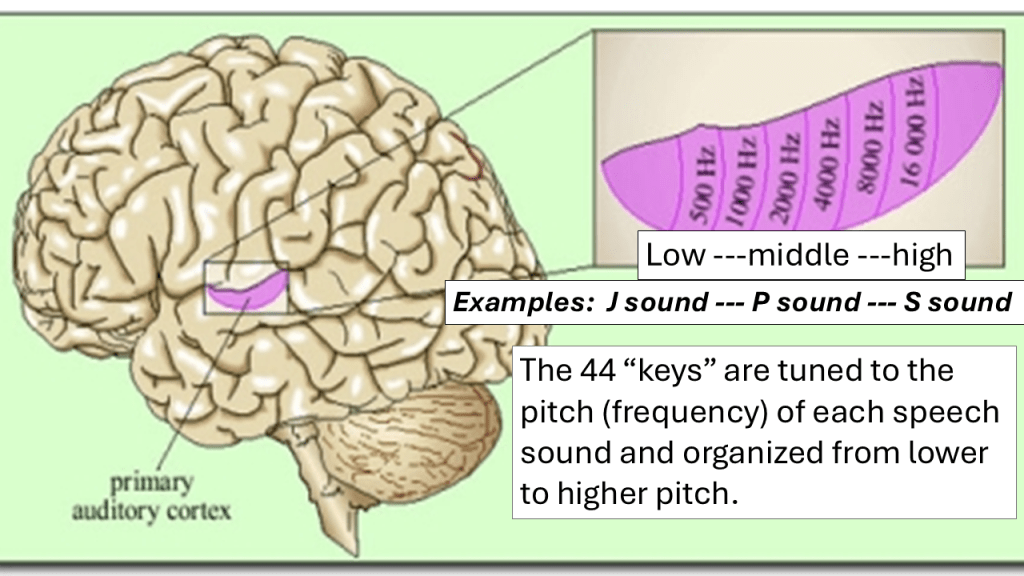
All our language abilities depend having a functional auditory system. Think about sounding out words. for example. The visual image “DOG” signals the auditory cortex first to play the key for the D sound, then the key for the O sound, then the key for the G sound. all in perfect order and in rapid succession, like an arpeggio on a piano. (“Keys playing” refers to neurons firing.)
What do we experience? We hear a rapid sequence of sounds sliding into each other, sounding the words inwardly. The print is talking to us, and reading is revealed to be inner speech. We might tell someone, “This book says. . .” or “This book is talking about. . .” because we hear the words on the page talking to us. At some point, if our auditory system is well-tuned, reading becomes as natural and easy as having a conversation with a good friend.
That is — If our auditory system is processing normally. If it’s “playing the keys” accurately, in the right sequence with the right timing and emphasis. And if it can screen out competing sounds and focus on a single speech stream required to understand both spoken and written language.
So . . . What happens if our auditory system is not processing sounds accurately? What happens to a person whose sound keys are out of tune? or if they play out of sequence? or are broken or missing? What if one key plays for two sounds? And what if the visual images of B and D both signal the same sound key to play? A child’s experience will be that there’s just one sound. He may think, “Oh, there are two ways to write that sound.”
For such a child, sounding out words will be a nightmare — the nightmare of dyslexia, arising from a poorly functioning auditory system.
(The more out-of-tune the child’s keyboard is, the more likely the child is to be identified as dyslexic. It’s a spectrum.)
What might words sound like to a person with significant auditory processing difficulty? Let’s listen to Kenny.
In the FF exercise below, Kenny, a 15-year-old with Auditory Processing Disorder, repeats recorded syllables as he hears them. These are ta, sa, ba, da, ka, and other c-v syllables. His perceptual difficulty leads to repeated errors. For years, errors in auditory perception had kept him from accurately pronouncing and decoding words (“sounding them out”).
Once Kenny had completed the Fast ForWord sound exercises (about nine weeks), his mother was stunned at his progress in processing speech sounds. “He can tell when he says a word wrong! He’s correcting himself!”
During these weeks, Kenny continued working with the school speech therapist, as he had done for years. Adding the Fast ForWord exercises to his ongoing speech therapy seemed to be magic (but it’s neuroscience of course). Though we do not have brain scans for Kenny, the combined power of good speech therapy and FF therapy clearly healed some of the hypoxia damage he had suffered at birth. Next step: Reading.
Let’s re-tune that keyboard.
Before Dr. Merzenich’s work on brain plasticity and Dr. Tallal’s work on auditory processing speed, children and adults simply had to adjust, had to find work-arounds, ways to compensate. But now families and schools have access to the correction, a way to “re-tune” the brain’s sound system.
Just think of using Fast ForWord as hiring a good piano tuner. Once the keyboard is in tune, the songs your child plays on it will be perfect.

 Karen Kennedy Reading Therapy