FAQs
How does reading therapy differ from tutoring?
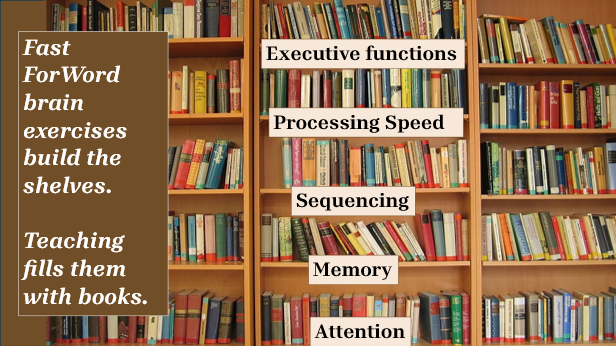
Therapy with Fast ForWord strengthens the brain’s auditory, language, and executive networks so they can receive and retain the content of tutoring.
Tutoring/instruction, on the other hand, provides content such as decoding rules and vocabulary and comprehension strategies. You can think of it this way: Brain networks “hold” the content of instruction like a bookshelf holds books.
Who can benefit from Reading Therapy?
• People of any age who want to read better. Our brains are plastic throughout our lives.
• Students not progressing well in other reading programs.
• Auditory processing difficulty.
• Dyslexia.
• Autism, SLI, or ADHD with significant reading difficulty.
• Red or yellow scores on K-2 DIBELS or other tests of early language.
• “Not proficient” or “Minimally proficient” on standardized tests such as MAP or STAR tests.
• Two years below grade level or stuck at 30th percentile or below.
• Referred for speech services or ex ed evaluation.
• Refuses to read out loud, avoids reading, guesses at words, needs pictures for hints.
• Spends two hours on a 30-minute homework assignment.
Which children is this therapy not recommended for?
• Down Syndrome
• Alexia
• Apraxia of speech
• Aphasia
• Uncorrected loss of hearing or vision
• Intellectual disability Note: I have seen some students with mild intellectual disability make solid gains in social conversations, language comprehension, focus, planning, and organization. These were special ed students at a high school in Phoenix Union HS District. Their teacher was highly committed to her students’ success in the program and made sure they “played the games” every day and had the quiet environment and support they needed. Growth in reading was not expected or measured. Our goal was growth in language competence and executive functioning.
What does it take to make this work?
• Initial conversation and assessment. No charge.
• Go / No-go decision based on assessments.
• Planning and scheduling conversation.
Please plan for the following:
• Parent presence with K-4 children. Older children and teens need lighter or little monitoring.
• Silent environment, good snack first.
• Laptop with reliable connection.
• Mouse.
• Two sets of padded headphones that cover the ears, one for the child, one for the parent guiding him. (No earbuds.) Do not use noise-cancelling headphones.
• Headset with a microphone when/if you use the optional Clear Fluency oral reading practice.
Schedule
• Week 1 (After testing and agreements):
Therapist Karen Kennedy guides parent and child through five daily sessions of 30-50 minutes. More sessions as needed until parent feels ready to take over.
• Week 2 and thereafter: Parent and student meet with Karen Kennedy one day a week for a guided session; parent and student complete daily sessions on their own the rest of the week. Karen monitors and reports your child’s daily progress online.
• No-Fooling-Around Protocol: Five days a week, 30-50 minutes a day.
• No breaks of over one day until after nine weeks or 45 hours of training. (Take laptop on trips.)
• Highly recommended: Handwriting and spelling activities that reinforce letter-sound matching. Parent implements this work.
• Highly recommended: Clear Fluency reading practice at three times a week after your child has finished Fast ForWord “basic-training.” Clear Fluency is bundled with your Fast ForWord exercises.
What could cause reading problems for my child?
Research reveals genetic causes for 40% to 70% of reading struggles. Disruptions in the brain’s language and reading areas can also arise from impacts such as these:
• slow auditory processing speed from any cause.
• stress hormones, especially in infancy (cortisol disrupts formation of synapses).
• ear infections in infancy.
• noisy environments in infancy and toddler-hood. (trucks, aircraft, AC units, TV in background).
• Ordinary NICU noise is also believed to traumatize the immature auditory system of pre-term infants. Click here for research.
• inadequate nutrition.
• birth distress with hypoxia.
• damage from exposure to lead or other toxins.
• We have no idea.
Q. How is such precisely targeted remediation possible?
The work is made possible by . . .
• advancements in brain imaging
• applying the principles of brain plasticity
• applying the principles of motivation
• use of “Hebbian learning” principles
• use of patented “super-consonants”
• sound stimuli that reproduce shifting consonant frequencies
• algorithms that adjust the stimuli to the child’s responses, slowing or accelerating task presentation.
• reinforcement timed in milliseconds
• cross-training of cognitive and perceptual skills.
• and a team of nerdy neuroscientists, psychologists, speech therapists, sound engineers, programmers, and data geeks at Scientific Learning committed to helping children.
 Karen Kennedy Reading Therapy